裸体美女黄色小电影|欧美的久久性视频|欧美成人黄色三级特A|自拍国模私拍视频第二页在线|怡红视频一区欧美乱伦电影网|tiantianjiujiu|三级无码电影艹干人妻电影|精品啪啪视频非洲A级片|高清无码日韩中文一区二区|91成人在线草在我视频

 
New study suggests Europe's oldest human fossil found in Greece
                 Source: Xinhua | 2019-07-12 19:37:38 | Editor: huaxia

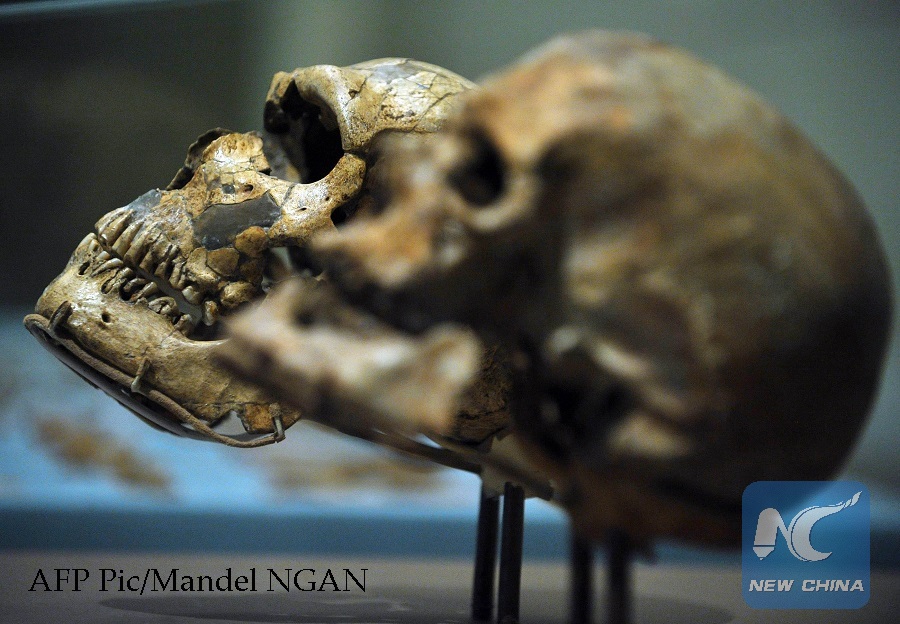
A March 17, 2010 photo shows the skull of the Homo Sapiens (Cro-Magnon 1) (R) from Cro-Magnon, France and the Homo Neanderthalensis (L) (La Ferrassie 1) from La Ferrassie Rock Shelter, France on display at the Smithsonian National Museum of Natural History in Washington, DC. (AFP PHOTO/Mandel NGAN)

ATHENS, July 12 (Xinhua) -- A new study on two fossilized human skulls discovered in southern Greece in the late 1970s could reveal details on the human migration in Eurasia, Greek media reported on Thursday.

A skull dated to more than 210,000 years ago represents the oldest human fossil outside of Africa, according to the researchers.

The skull would become the oldest Homo Sapiens fossil found in Europe.

Another skull dated to more than 170,000 years ago has a Neanderthal-like morphological pattern.

"These results suggest that two human groups were present at the site; an early Homo sapiens population, followed by a Neanderthal population," head researcher Katerina Harvati, a Greek professor of paleoanthropology at the University of Tubingen in Germany explained speaking to AMNA following Wednesday's official announcement.

"Our findings support multiple dispersal of early modern humans out of Africa and highlight the complex demographic processes that characterized human evolution and modern human presence in southeast Europe," Greek media quoted Harvati on Thursday.

The two skulls (named Apidima 1 and 2) were found together in the late 1970s in the Apidima Cave located in the Peloponnese peninsula in southern Greece.

The team from Greece, Germany and Britain virtually reconstructed both skulls, provided detailed comparative descriptions and analyses, and dated them using uranium radiometric methods.

"As a Greek, I wish that research will continue in Greece. I believe our country has much more to contribute to Paleoanthropology science," Harvati said.

Back to Top Close
Xinhuanet

New study suggests Europe's oldest human fossil found in Greece

Source: Xinhua 2019-07-12 19:37:38

A March 17, 2010 photo shows the skull of the Homo Sapiens (Cro-Magnon 1) (R) from Cro-Magnon, France and the Homo Neanderthalensis (L) (La Ferrassie 1) from La Ferrassie Rock Shelter, France on display at the Smithsonian National Museum of Natural History in Washington, DC. (AFP PHOTO/Mandel NGAN)

ATHENS, July 12 (Xinhua) -- A new study on two fossilized human skulls discovered in southern Greece in the late 1970s could reveal details on the human migration in Eurasia, Greek media reported on Thursday.

A skull dated to more than 210,000 years ago represents the oldest human fossil outside of Africa, according to the researchers.

The skull would become the oldest Homo Sapiens fossil found in Europe.

Another skull dated to more than 170,000 years ago has a Neanderthal-like morphological pattern.

"These results suggest that two human groups were present at the site; an early Homo sapiens population, followed by a Neanderthal population," head researcher Katerina Harvati, a Greek professor of paleoanthropology at the University of Tubingen in Germany explained speaking to AMNA following Wednesday's official announcement.

"Our findings support multiple dispersal of early modern humans out of Africa and highlight the complex demographic processes that characterized human evolution and modern human presence in southeast Europe," Greek media quoted Harvati on Thursday.

The two skulls (named Apidima 1 and 2) were found together in the late 1970s in the Apidima Cave located in the Peloponnese peninsula in southern Greece.

The team from Greece, Germany and Britain virtually reconstructed both skulls, provided detailed comparative descriptions and analyses, and dated them using uranium radiometric methods.

"As a Greek, I wish that research will continue in Greece. I believe our country has much more to contribute to Paleoanthropology science," Harvati said.

010020070750000000000000011100001382215331