Xinhua Commentary: Japan's neo-militarism becoming clear and present danger

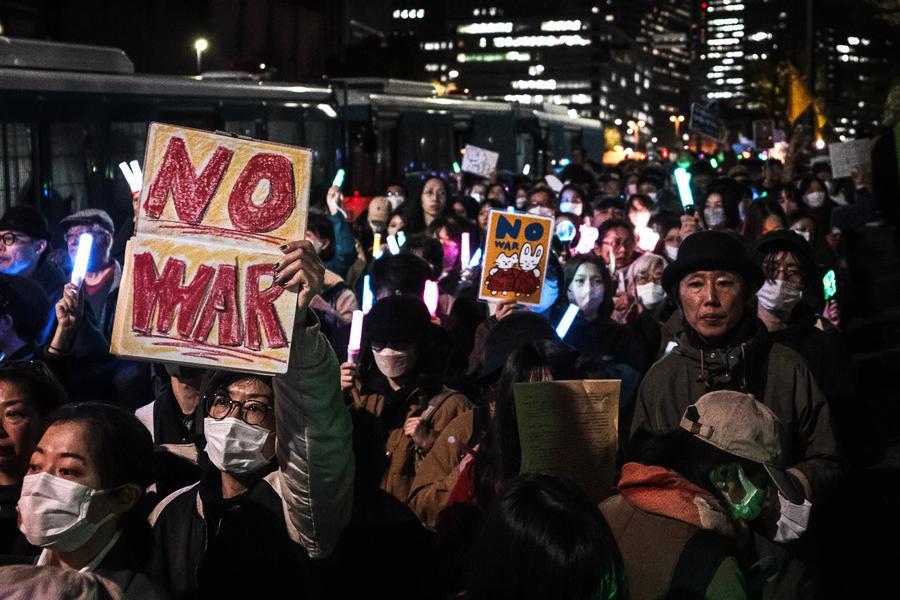
History shows that the failure to make a clean break with militarism after World War II keeps its remnants alive in Japan's right-wing circles.
TOKYO, April 19 (Xinhua) -- The transit of a Japanese destroyer through the Taiwan Strait on Friday was a deliberate show of force that severely undermines the political foundation of China-Japan relations and poses a direct threat to China's sovereignty and security.
The transit came at a time of heightened tensions following Japanese Prime Minister Sanae Takaichi's remarks on the Taiwan question. Rather than easing strains, Tokyo has doubled down on provocation, compounding its earlier missteps and sending a dangerous signal that the Japanese right wing is bent on expanding Japan's military forces and attempting to revive militarism.
In November last year, Takaichi publicly claimed that a Taiwan contingency could constitute a "survival-threatening situation" for Japan, implying possible military involvement. The remarks significantly eroded mutual trust and ran counter to Japan's explicit commitments on the Taiwan question under the four political documents between China and Japan. Despite repeated calls from Beijing to retract such erroneous comments, Tokyo has attempted to blur the issue with vague assertions that its position "regarding Taiwan remains unchanged."
The latest naval maneuver only fuels concerns that certain elements within Japan are seeking possible military intervention in the region and undermining peace and stability across the Taiwan Strait.
Japan has been accelerating its military buildup, steadily loosening the constraints of its exclusively defense-oriented policy. Recent steps include a major restructuring of the Maritime Self-Defense Force to enhance combat capabilities, the deployment of long-range missiles with so-called "counterstrike capabilities" in Kumamoto Prefecture, and plans to deploy medium-range surface-to-air missiles to Yonaguni Island, located only 110 km from Taiwan. Such moves have extended Japan's military reach directly into China's periphery and seriously undermined peace and stability across the Taiwan Strait.
Furthermore, right-wing forces in Japan have continued to hype up "threats from neighboring countries" and stir regional tensions, using such narratives as a pretext to ease military constraints and advance their ambition of remilitarization.
This closely mirrors the logic of Japan's historical militarism. From Takaichi's erroneous remarks on the Taiwan question to the rollout of expanded military capabilities and the overt transit of a destroyer through the strait, a series of aggressive moves revealed the growing danger posed by neo-militarism in Japan.
History shows that the failure to make a clean break with militarism after World War II keeps its remnants alive in Japan's right-wing circles. In recent years, such forces have pushed boundaries through incremental steps, eroding legal and institutional constraints. The risky moves, such as the new security legislation, easing limits on collective self-defense, revising security strategies, relaxing arms export, and blatantly advocating nuclear sharing, all point to a thrust to weaken the core principles of Japan's pacifist constitution and advance remilitarization.
These institutional loosenings, coupled with moves by some politicians to whitewash past aggression, such as tampering with textbooks and visiting the notorious Yasukuni Shrine, ultimately aim to cast off the dual constraints of the postwar international order and Japan's own legal framework. Such a dangerous trend, pursued in the name of "national normalization" but in essence advancing a form of neo-militarism, warrants heightened vigilance from the international community.
History must not be forgotten. The Japanese militarism once brought immense suffering to China, other Asian countries and the wider world. China will never allow the Japanese militarism to stage a comeback, and the people of the Asia-Pacific countries will never allow a repeat of past tragedies.
The Taiwan question stands at the very core of China's core interests and constitutes a red line that must not be crossed. The provocative passage of the Japanese destroyer through the Taiwan Strait will only arouse strong indignation among the Chinese people. Japan must pull back from the brink, correct its course, adhere to the one-China principle and the spirit of the four political documents between China and Japan, and refrain from going further down the wrong path.■












Comments