
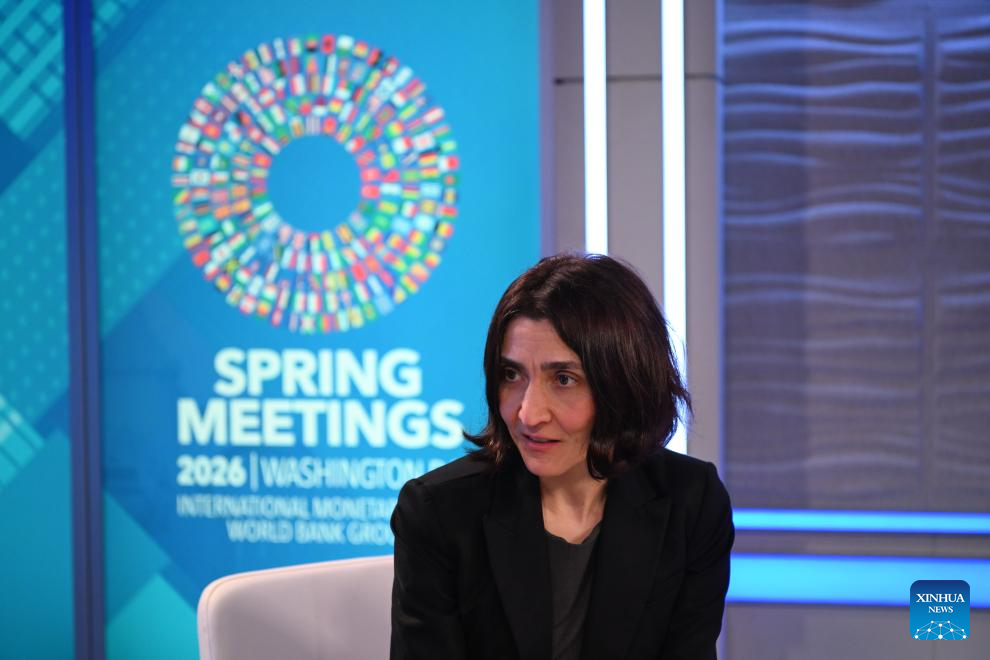
Deniz Igan, chief of the International Monetary Fund (IMF) Research Department's World Economic Studies Division, receives an interview with Xinhua during the 2026 Spring Meetings of the IMF and the World Bank Group in Washington, D.C., the United States, April 14, 2026. (Xinhua/Li Rui)
by Xiong Maoling, Li Rui
WASHINGTON, April 18 (Xinhua) -- The global energy disruption caused by the U.S.-Israel war with Iran could help accelerate global transition toward renewable energy in the long run, offering a potential upside amid the broader energy shock, an International Monetary Fund (IMF) official has said.
"This would possibly be a silver lining," Deniz Igan, chief of the IMF Research Department's World Economic Studies Division, told Xinhua in an interview on Tuesday during the ongoing 2026 Spring Meetings of the IMF and the World Bank Group.
As more countries have turned to thinking seriously about energy transition and energy security in the past five years, Igan said, it is time for countries to seize the moment to actually put in place policies that could both serve them in the current juncture, facing the current shock, but also in the long term.
"In accelerating energy transition, our stance is that rather than using the limited resources countries have on generalized subsidies that would distort price signals and that would actually hold back energy transition, it's better spent also for the medium term on fostering energy transition," Igan added.
In the latest World Economic Outlook (WEO) report released Tuesday, the IMF said that the closing of the Strait of Hormuz and serious damage to critical facilities in a region central to global energy supply raise the prospect of a major energy crisis should hostilities continue.
It also noted that the war in the Middle East should spur faster adoption of renewable energy, which can strengthen resilience to energy shocks, improve energy security and support the climate transition.
"The way we start our forecasting exercise at IMF is starting with a set of global assumptions on commodity prices," Igan explained. However, oil and gas markets are highly volatile, with prices fluctuating continuously from day to day. This makes it difficult to pin down a stable set of assumptions that would remain relevant amid ongoing developments, she added.
"It's one of many potential outcomes," she said, noting it's also important to place greater emphasis on alternative scenarios.
As the global economy faces another shock, the impact varies significantly across countries, according to the WEO report.
The war in the Middle East is impacting the global economy through three main channels -- commodity prices, inflation expectations and financial conditions, Igan said.
"Emerging market and developing economies are much more sensitive to changes on all these three channels," she added. ■
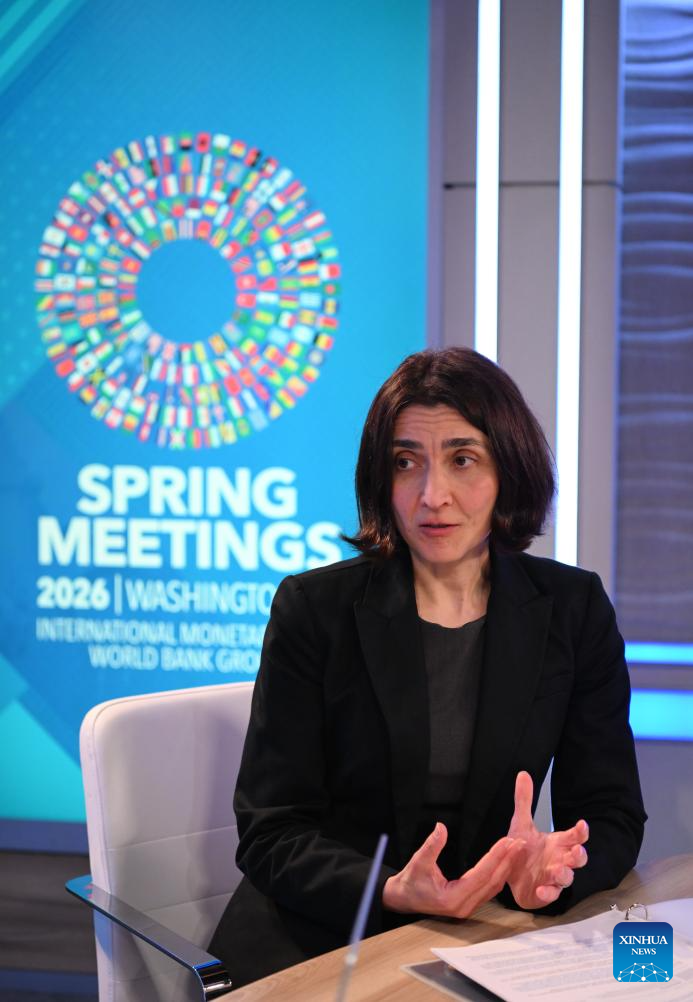
Deniz Igan, chief of the International Monetary Fund (IMF) Research Department's World Economic Studies Division, receives an interview with Xinhua during the 2026 Spring Meetings of the IMF and the World Bank Group in Washington, D.C., the United States, April 14, 2026. TO GO WITH "Interview: IMF official says conflict-induced energy shock may nudge renewables shift" (Xinhua/Li Rui)