
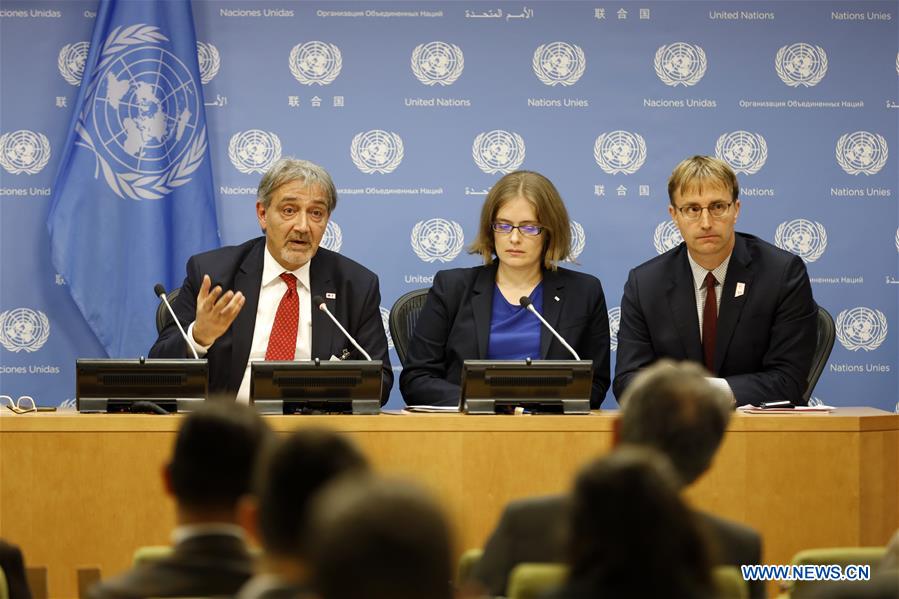
International Federation of Red Cross and Red Crescent Societies (IFRC) President Francesco Rocca (L, Rear) speaks to journalists during a press briefing on the release of an IFRC report The Cost of Doing Nothing, at the UN headquarters in New York, on Sept. 19, 2019. A new report by the International Federation of Red Cross and Red Crescent Societies (IFRC) warned that the number of people needing humanitarian assistance every year as a result of climate-related disasters could double by 2050. (Xinhua/Li Muzi)
UNITED NATIONS, Sept. 19 (Xinhua) -- A new report by the International Federation of Red Cross and Red Crescent Societies (IFRC) warned that the number of people needing humanitarian assistance every year as a result of climate-related disasters could double by 2050.
Released on Thursday, the report The Cost of Doing Nothing estimated that the number of people in need of humanitarian assistance as a result of storms, droughts and floods could climb beyond 200 million annually, compared to an estimated 108 million today.
It further suggested that this rising human toll would come with a huge financial price tag, with climate-related humanitarian costs ballooning to 20 billion U.S. dollars per year by 2030, in the most pessimistic scenario.
Speaking in the run-up to the UN Climate Action Summit, IFRC President Francesco Rocca said that the findings have shown the strain that increasing climate-related disasters could place on aid agencies and donors.
"The report shows the clear and frightening cost of doing nothing. But it also shows there is a chance to do something," he said.
By investing in climate adaptation and disaster risk reduction, including through efforts to improve early warning and anticipatory humanitarian action, the world can avoid a future marked by escalating suffering and ballooning humanitarian response costs, said Rocca.
The report also said that by taking determined and ambitious action now that prioritizes inclusive, climate-smart development, the number of people in need of international humanitarian assistance annually could in fact fall to as low as 68 million by 2030, and even drop further to 10 million by 2050, which is a decrease of 90 percent compared to today.